Face · Nervous System
Where your face holds the day
Your jaw, your eyes and your forehead each store a different kind of effort. A map of what the face is carrying, and why it doesn't let go on its own.
Right now, are your teeth touching?
If they are, your jaw is working. At rest the lips are closed, the teeth are slightly apart and the tongue lies against the roof of the mouth. Most of the women I meet have not had their teeth apart since breakfast. They are not chewing anything. They are holding.
Your face has been working all day. It rarely gets asked to stop. That is the entire premise of The Face You Wear All Day, the evening we run in SoHo, and it is worth understanding before you ever try to release anything.
A dashboard, not a surface
We are taught to treat the face as a surface: something to be looked at, corrected, kept up.
I think of it as a dashboard. Effort, emotion, attention and social performance show up in the jaw, the eyes, the forehead, the breath and the voice, often before we consciously register that we are under pressure. Your jaw tightens. Your lips press. Your eyes narrow. Your forehead fixes. Your breathing goes shallow. All of this happens first, and the thought “I am stressed” arrives later, if it arrives at all.
The face is where the internal and external worlds meet, and it is directly wired to the nervous system. That makes it the most accessible place to read what is happening in the whole system, and the most accessible place to start changing it. Not because the face is the problem. Because it is the readout.
Three places the day gets stored
Different kinds of effort live in different parts of the face. After fifteen years of this I can usually tell which day someone has had by which third of the face is doing the work.
The lower face: jaw, mouth, chin, neck. This is the guard. Clenched teeth, pressed lips, a chin that pulls tight, a neck that feels like a column. The jaw holds what we did not say, the pushing-through, the stubbornness, the swallowed reaction. It is the face of a woman who is being capable at everyone. It is also the region most people wake up with already tense, because the guard does not go off duty just because you fell asleep.
The mid-face: eyes, cheeks, the area under the eyes. This is watchfulness and screen fatigue. Narrowed eyes, cheeks that have stopped moving, an expression that reads as tired or compressed even when you are not tired. Eight hours of looking at a rectangle at arm’s length trains the eyes to focus hard and the cheeks to stop participating. The result is a face that looks guarded, and a guarded face feeds a guarded state.
The upper face: forehead, brow, the space between the eyebrows. This is alertness. Habitual frowning, lifted eyebrows, a forehead that keeps working after the task is over. The upper face holds surprise, fear, information overload and the particular effort of appearing interested and agreeable in a meeting. Many women lift their brows all day without knowing it, as a small permanent performance of attentiveness.
Why it doesn’t let go by itself
A held muscle is not a mistake. It is a message that arrived, did its job, and never got the signal that the situation was over.
A muscle clamp is what happens when a group of muscles stays tense long after the moment that needed it has passed. The meeting ended two hours ago. The jaw did not get the memo. And here is the part that makes this more than a cosmetic issue: the nervous system reads the held jaw as evidence that the threat is still present. There is an old idea in psychology that the physical expression does not only follow the feeling, it can produce it. A braced face keeps the body braced. The tension and the state feed each other in a loop, and neither of them will break it on its own.
This is why “just relax” is useless advice. You cannot relax a muscle you have not noticed you are holding, and you cannot notice it from inside the state that is holding it.
Six questions to ask your face
Before any technique, read the dashboard. These are the questions I ask a room before we touch anything, and the reading step of how we work:
- Are your teeth touching, or your lips pressed together?
- Where is your tongue resting: on the roof of the mouth, or pushed against your teeth?
- Do you wake with a tense or restricted jaw?
- Do you frown, lift your eyebrows or narrow your eyes without realising it, especially on video calls?
- Does screen time leave your face, neck or shoulders feeling compressed?
- Are you breathing freely, or quietly holding your breath while you concentrate?
You do not need to score this. If three of those made you adjust something as you read them, you already know where your day lives.
What actually helps
Not more effort. The face does not need a workout; it needs a different pattern.
The order that works is the one Rare Human is built on: notice, translate, respond. First you catch the held place. Then you read what it is protecting: is this tiredness, alertness, a swallowed sentence, or simply a habit that outlived its reason? Only then do you choose the response, and the response is almost always smaller than you think.
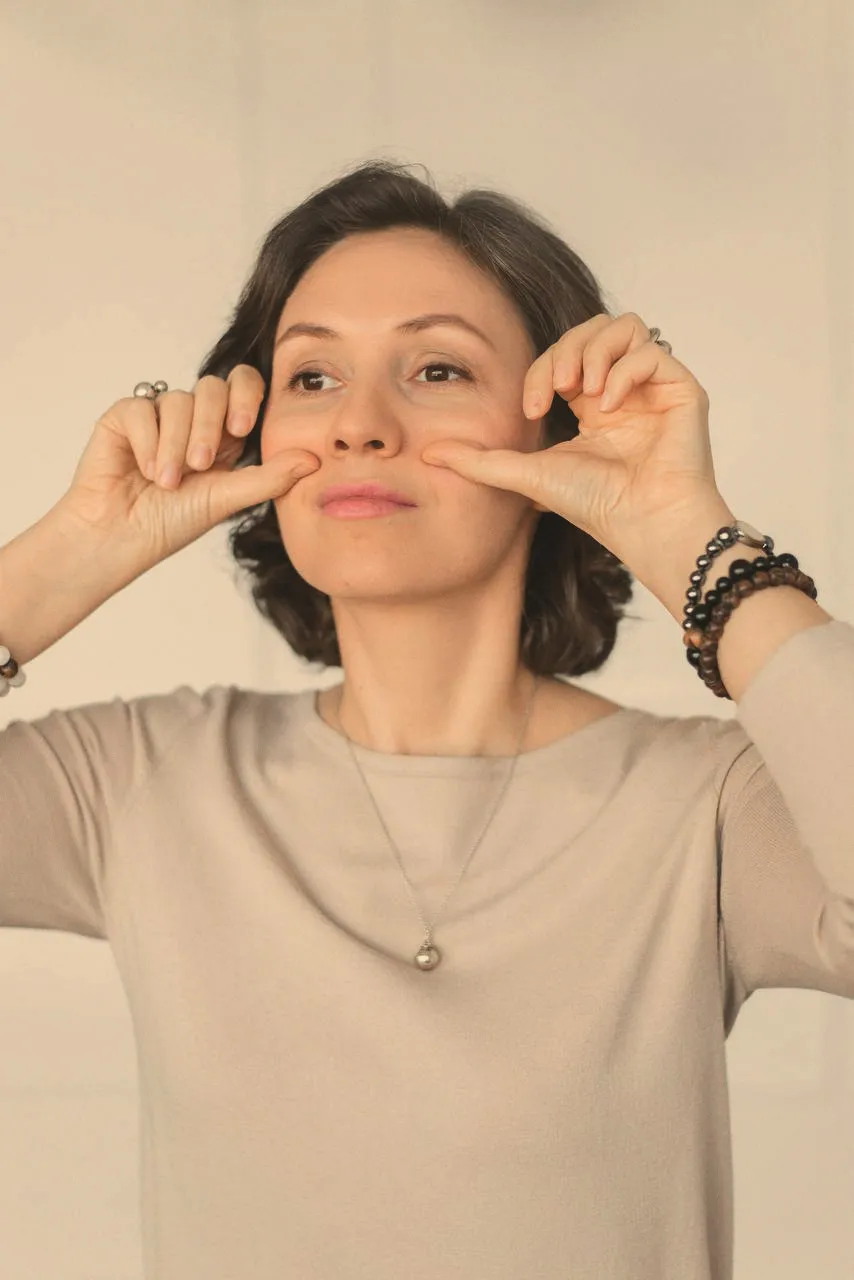
For the jaw: put your fingertips on the muscle just in front of your ears, let the teeth part, let the tongue drop from the roof of the mouth, and breathe out for longer than you breathed in. The neck belongs to this too. A held jaw is almost never held alone, so let the shoulders drop while you are there.
For the eyes and cheeks: look at something further away than your screen, let the gaze go soft rather than sharp, and let the cheeks lift once on purpose, then fall. The face has to be reminded it is allowed to move.
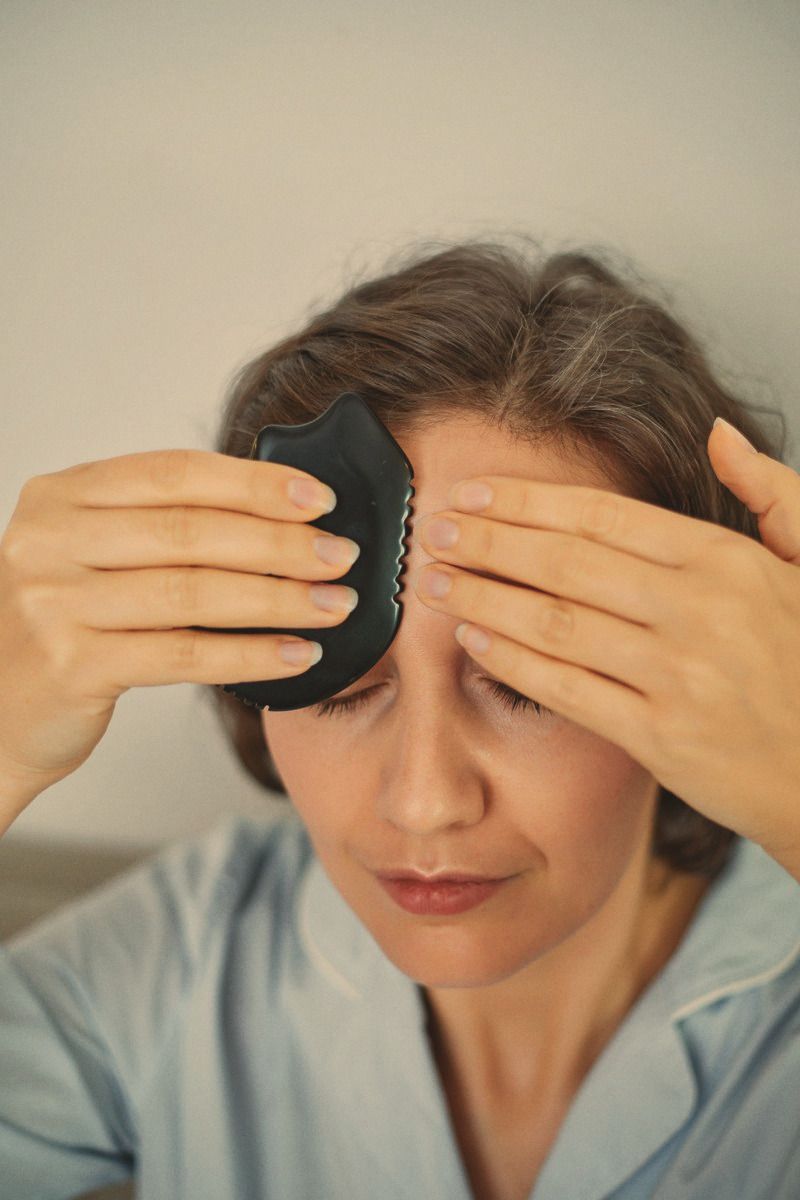
For the forehead: place a hand flat across it and let the brow rest into your palm for three breaths. Most people are surprised by how much the forehead was doing.
Two minutes. That is the whole practice. Nothing is performed and nothing is corrected. What you get is not a different face; it is a different state, and the face follows.
Where I still catch myself
I catch my own jaw most often when I am speaking English on a stage, or writing something I care about and am afraid of getting wrong. The guard comes up. The tongue presses. Somewhere in my body I am still a girl in a post-Soviet classroom trying not to embarrass herself.
I do not treat that as a failure any more. I treat it as information, the way I would treat the fuel light in a car. It tells me which state I am in, and it gives me the one thing correction never gave me: a place to start.
Persistent jaw pain, locking or significant discomfort belongs with a dentist or a physician before you do any facial work at all. This is education and shared practice, not treatment.
If mornings are where you notice it most, read why your face is puffy in the morning, which covers the fluid side of the same story. The Face You Wear All Day is the two-hour evening in SoHo where we walk this map with our hands. If the voice is where you hold it, Jaw, Voice and Presence goes deeper on the lower face, and for workplaces the same material runs as Face as a Dashboard of the Nervous System.